Age of Muses

Age of Muses

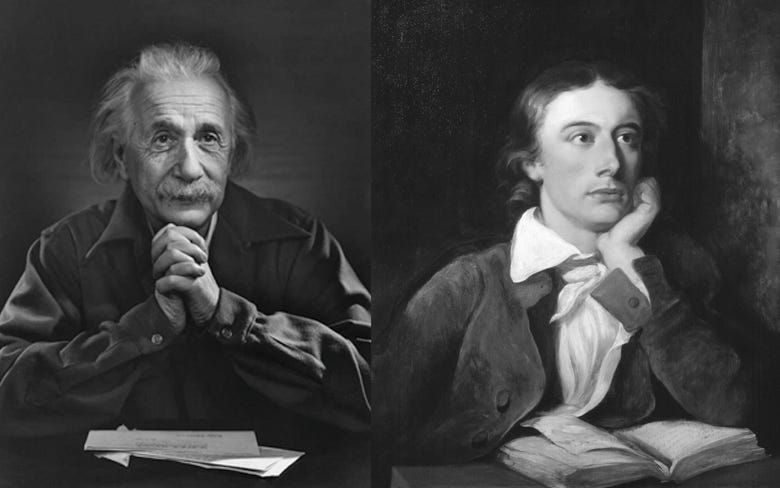
Negative Capability: The Genius of Keats and Einstein

By David Gosselin

David Gosselin's avatar
David Gosselin
Aug 13, 2021
∙ Paid

“To develop a complete mind: Study the science of art; Study the art of science. Learn how to see. Realize that everything connects to everything else.”
—
Leonardo Da Vinci

There exists a deeply held belief that madness and creativity share a special kinship. They do not. However, they may have certain similarities and be confounded. From caricatured depictions of Edgar Allan Poe as some perverse storyteller whose ideas were simply the product of his own sick mind to the false portrayal of actually schizophrenic adherents to “Game-Theory” dogma as genuine “geniuses” (as in the movie A Beautiful Mind), popular culture has often dwelt on the similarities between creativity and madness, but not the areas where they diverge. Indeed, the idea that one was the result of the other is not unpopular. The differences between the two states of mind are seldom a conscious object of investigation—despite the obvious differences.

While truly original thinkers are often portrayed as mad men—individuals driven by some higher power which they have no control over and must serve—the fact is that genius has characteristics that any individual may acquire, practice, and willfully hone to varying degrees.

In a word: genius has often been treated as some kind of nebulous anomaly, an epiphenomenon that should be appreciated whenever it appears, as in the case of Da Vinci, Shakespeare, Beethoven, or Einstein, but rarely understood. The how of genius is rarely discussed as a general way of thinking.

But where to start? How should the question of genius be approached? What or how does genius know?

We can start with a few principles, namely: that everything is a combination of “known” and “unknown.” For instance, everything we view with our eyes is made up of tiny particles. These tiny particles are constantly in motion (for reasons we cannot fully explain) and yet we walk by an endless number of objects and persons which appear at complete rest to our senses. We can interact with these different objects despite not having complete knowledge of how they work. We refer to this collective aggregation of tiny particles as “matter.” However, what we refer to as “matter” expresses itself in many seemingly contradictory forms.

Plato identified this fundamental paradox in his “Timaeus” dialogue. He used the example of fire and explained that we should not refer to fire as “this fire” but rather “thus fire”—fire being only one of the many discrete expressions of a principle called “matter.” We know or have experienced many expressions of matter; we have seen matter take many different forms, but we have never seen matter per se—it remains an “unknown.” Today, we know that fire is actually a plasma, a state of matter in which particles have been stripped of their electrons, resulting in an ionized gas—fire is a “known-unknown.”

All our experiences—even the most mundane—are a combination of the “known” and “unknown.” The crucial question is: how does genius approach the relationship between the “known”, “known-unknown” and “unknown”?

The poet John Keats famously identified a concept which allowed him to define and isolate his own unique quality of “genius.” It was a quality which he saw a great deal of in Shakespeare. Keats called this quality “Negative Capability”:

“At once it struck me what quality went to form a Man of Achievement, especially in Literature, and which Shakespeare possessed so enormously — I mean Negative Capability, that is, when a man is capable of being in uncertainties, mysteries, doubts, without any irritable reaching after fact and reason[…]”

The reader should be cautioned: Keats’ phrasing of “without any irritable reaching after fact and reason” is not the expression of some Modernist or Post-Modernist view; it does not imply that Keats was not concerned about the question of facts and reason in respect to art, as many modern literary critics imagine—quite the contrary. Keats’ correspondences and poetic works attest to his deep conviction about the poetic  imagination’s ability to capture Truth in its purest form. Keats believed that the best way to arrive at facts and reasons was to stop looking for them per se, and allow the mind to explore things on its own; to let the imagination play among phenomena and allow the facts and reasons find it—much in the same way we might imagine a poet being found by the muses.

Creative Miracles

In the spring of 1819 Keats experienced one of the greatest bursts of creativity in the history of science and art. Among other works, he composed his five Great Odes which defined a density of idea and poetical irony never achieved before with the English ode. Among the most celebrated odes were his “Ode to a Nightingale” and “Ode on a Grecian Urn.”

In the “Ode to a Nightingale,” Keats describes one of his poetic “visions” in which the beautiful song of a nightingale awakens a deeper awareness within himself about the nature of human mortality. However, this awareness of mortality becomes the route which leads Keats to the deeper investigation of a fundamentally different, although related concept: immortality. The acceptance of one’s inevitable mortality becomes the impetus for a deeper investigation into what lies beyond individual mortality. What is left behind? What persists? What is the character of that which persists beyond the bounds of mortality?

As Keats explores the question, his attention is directed away from any notion of particulars—in this case, the nightingale’s song—to the source of music itself—the Platonic “One” which transcends the infinite expressions of the “Many.”

If the nightingale, the musician or the hand that plucked the strings fades, wherein lies the true source of music?

As Keats explores the question, he arrives at the limitations of the sense-perceptual dimensions of the subject; he directs our attention away from the material towards the immaterial—from the seen to the unseen. So Keats wonders what the nature of his experience was, whether it was a “vision,” a “dream,” or something else?

Adieu! adieu! thy plaintive anthem fades
         Past the near meadows, over the still stream,
                Up the hill-side; and now ’tis buried deep
                        In the next valley-glades:
         Was it a vision, or a waking dream?
                Fled is that music:—Do I wake or sleep?

In the “Ode to a Nightingale,” Keats describes an awakening of what is essentially his “negative capability”; he describes ever-increasing levels of awareness which do not merely pertain to the immediate moment being experienced, or even an awareness of all possible moments in time, but rather the nature of that which lies beyond all moments, beyond all time—timelessness.

In his “Ode on a Grecian Urn,” Keats continues to explore the breakthroughs in his “negative capability” by composing what is arguably his greatest poem. Keats opens his “Ode on a Grecian Urn” with a flurry of questions provoked by the images painted on an ancient urn, questions about its origins, purpose and its story:

What leaf-fring’d legend haunts about thy shape
       Of deities or mortals, or of both,
               In Tempe or the dales of Arcady?
       What men or gods are these? What maidens loth?
What mad pursuit? What struggle to escape?
               What pipes and timbrels? What wild ecstasy?

The silent scenes on the urn—its “pipes” and “timbrels”—tease out new questions concerning the nature of time and mortality. Keats is increasingly drawn away from the domain of his immediate or direct perceptions of the urn and begins to define one of the most revolutionary poetic investigations into the nature of that which is not directly perceivable but indirectly perceivable—from the domain of the material world to the domain of the immaterial world—from the heard to the unheard—the “spirit” ditties:

Heard melodies are sweet, but those unheard
       Are sweeter; therefore, ye soft pipes, play on;
Not to the sensual ear, but, more endear’d,
       Pipe to the spirit ditties of no tone:

The images and actions found in the plastic arts of classical Greece move us not because of what we see directly before us as the stillness or silence of the works, but because of what we see indirectly, the unseen motions and unheard melodies provoked by such works. We cannot directly perceive these motions—the sculptures are frozen—but we are made aware of them on account of the sheer irony and metaphorical quality captured by the form imparted to the Grecian marble by the sculptor. The unseen motions are the true subject, which in the world of the seen, appear only as glimpses.

Just as the forms embodied by classical Greek sculptures instilled a heightened awareness in Keats, which he described in his sonnet “On First Seeing the Elgin Marbles,” so too have the images on a Grecian urn completely seized his attention. They have seized his attention not by virtue of what he experiences directly before him, but because of the attention that experience generates in respect to the world existing beyond the urn. The urn is a mere shadow of a world; its images are not the subject, only the predicates for the reality unfolding within Keats’ creative imagination—the urn is merely the seen aspect of an unseen world.

This, when rightly understood, is the essence and function of true metaphor.

Whether in sculpture, painting, poetry, or any timeless art form, the purpose of great irony and metaphor is to bring our attention to something specific, to make us “aware” of that which lies not only directly before us, but also indirectly, beyond. By provoking an awareness within, we become capable of perceiving our true subject in the world outside. Great works of beauty allow us to bridge this gulf between two seemingly disparate worlds; the realization of the awareness which makes us capable of recognizing something new on the outside world compels a consciousness of the reality which must necessarily exist within.

We are thus speaking of something specific—an “insight”—which does not belong to the world of sense, but to the world of ideas. These unseen ideas have just as objective a reality as the world of the seen—only the conditions are different.

What are these conditions?

Rather than having a specific breadth, depth and length, or any sense-perceptual characteristic, an idea has no directly perceivable characteristics. However, just because something has no directly perceivable characteristics, does that mean it does not have indirectly perceivable characteristics? Is there not a whole series of possible indirectly perceivable characteristics?

In the case of Shakespeare, the actions of his dramas are not only the actions on a stage, they are the actions off the stage, the actions in our minds, the questions our minds must consider in order to make sense of the world unfolding before our eyes; the mind must consider the indirectly perceivable questions or intentions which translate into the directly perceivable actions on the stage. Without the existence of these indirectly perceivable or directly unperceivable actions, there would be no basis for the directly perceivable actions on the stage. The same goes for the heard notes of a melody, or the seen actions of sculptures. Thus, Keats declares “Heard melodies are sweet, but those unheard are sweeter.”

Keats is hinting at his real subject by identifying the tension between two fundamentally different worlds.

Several directly unperceivable thought objects are defined in “Ode on a Grecian Urn’s” second stanza. Keats’ poetic approach is no mere literary device: he is compelling our minds to conceive of the non-literal, though as objectively definable thought-objects, or gestalts. It is the ironical juxtaposition of these questions or “thought-objects” that causes us to arrive at Keats’ higher metaphorical meaning—the metaphor of metaphors—the intimate relationship between “Beauty” and “Truth,” mortality and immortality

Fair youth, beneath the trees, thou canst not leave
       Thy song, nor ever can those trees be bare;
               Bold Lover, never, never canst thou kiss,
Though winning near the goal yet, do not grieve;
       She cannot fade, though thou hast not thy bliss,
               For ever wilt thou love, and she be fair!

These moments frozen in time capture the tension between a changing world and an unchanging world—the “One” and the “Many.” Keats proceeds to further investigate the implications of his theme and its relation with his own personal mortality:

Ah, happy, happy boughs! that cannot shed
         Your leaves, nor ever bid the Spring adieu;
And, happy melodist, unwearied,
         For ever piping songs for ever new;
More happy love! more happy, happy love!
         For ever warm and still to be enjoy’d,
                For ever panting, and for ever young;
All breathing human passion far above,
         That leaves a heart high-sorrowful and cloy’d,
                A burning forehead, and a parching tongue.

Keats relishes the seeming suspension of reality captured by the static nature of the urn. He explores all of its poetic possibilities. However, these are not freedom-of-associations—Keats is hypothesizing: it is the power and freedom inherent in his choosing to allow his mind to explore the possibilities before him—his “Negative Capability”—without necessarily knowing what they will lead to—which defines the immense creative tension between the past, present, future, and all time—timelessness.

Keats transports us into the domain of what may be aptly called the simultaneity of eternity. This stunning poetic prescience defines the true genius of his “Negative Capability” and its ability to investigate the nature of immaterial ideas, rather than the objects and particulars of a material world.

User's avatar

Continue reading this post for free, courtesy of David Gosselin.

Or purchase a paid subscription.
© 2026 David Gosselin · Privacy ∙ Terms ∙ Collection notice
Start your SubstackGet the app
Substack is the home for great culture