Age of Muses

Age of Muses

The Legislation of Lycurgus and Solon by Friedrich Schiller

Translation

David Gosselin's avatar
David Gosselin
Jun 13, 2024
∙ Paid
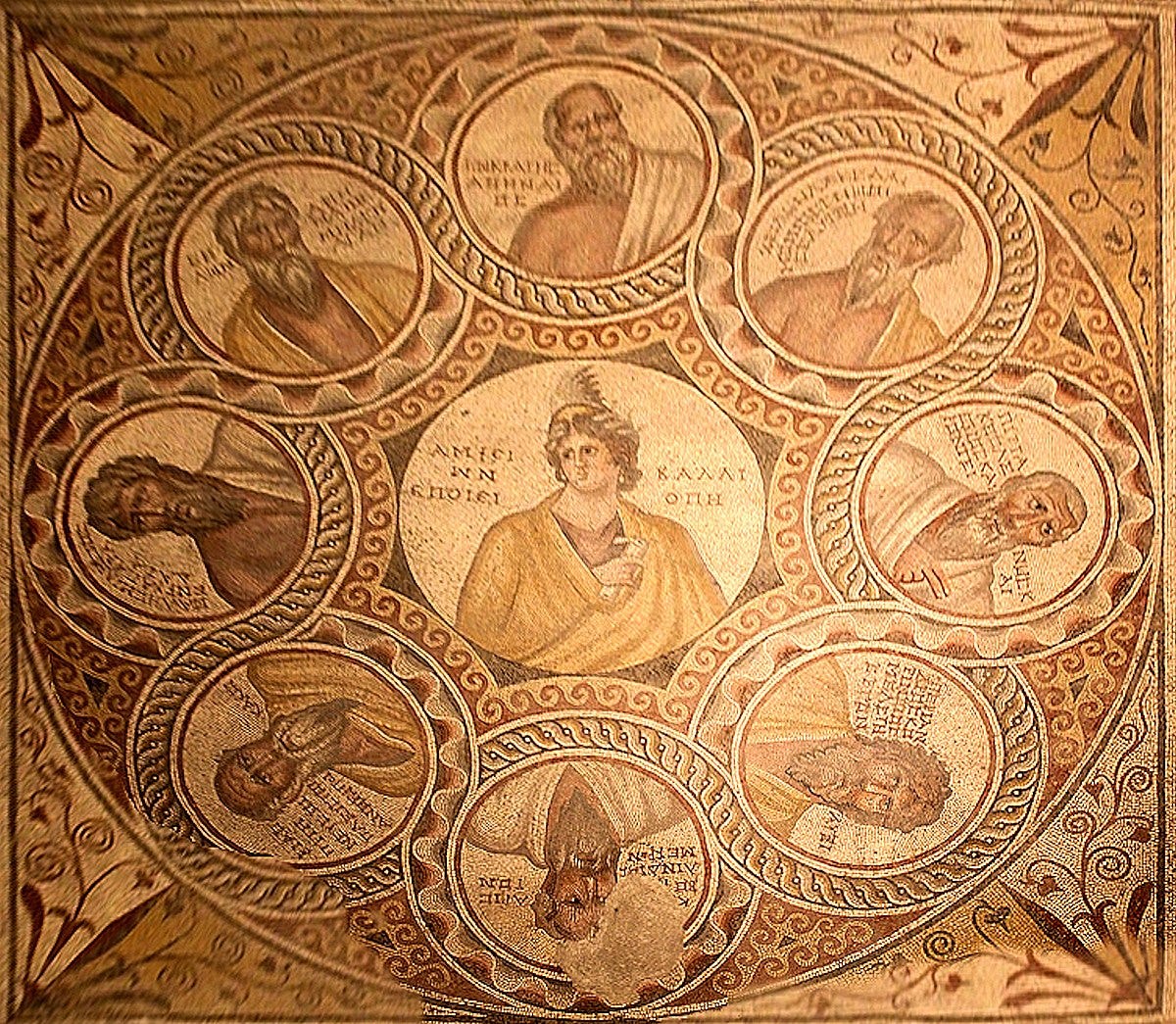
Mosaic of the Seven Sages, Baalbeck, Lebanon, century A.D., National Museum of Beirut, Lebanon. Calliope at the center, and clockwise from top: Socrates, Chilon, Pittacus, Periander, Cleobulus (damaged section), Bias, Thales, and Solon

To truly appreciate the nature of the Lycurgian plan, we must understand Sparta’s political situation at the time, and the conditions under which Lycurgus found Lacedaemon when he unveiled his new plan. Two kings held the same authority and simultaneously served as the heads of state; each was jealous of the other, and each was concerned with building his own following, to thus limit the authority of his rival. Their jealously had been inherited from the two previous kings, Prokles and Eurysthes, and their lineages down to Lycurgus, such that Sparta was constantly plagued by factional struggles. Each king sought to bestow more freedoms on the people to win their favor, and these gifts inspired insolence within the population, leading to insurrection. The state was rocked by chaos and vacillated between monarchy and democracy. Boundaries between the rights of people and the authority of kings had not yet been properly defined, and wealth remained in the hands of a few families. The rich tyrannized the poor, and the latter’s misery resulted in revolt.

Plagued by internal discord, the weakened state predictably fell victim to hostile neighbors, or dissolved into various smaller tyrannies. And this is how Lycurgus found Sparta: no clear distinction between the authority of kings and the people, an unequal distribution of goods and wealth, a lack of public harmony and spirit of cooperation, and complete political bankruptcy—all these were symptoms confronting the legislator, which he had to take into consideration when framing his new laws.

When the day arrived and Lycurgus planned to announce his new legislation, he had thirty of the most prominent citizens, whom he had recruited to his plan, appear in the marketplace with arms, to frighten anyone who might wish to resist. King Charilaus, fearful of these measures, sought refuge in the Temple of Minerva, since he believed Lycurgus’ plan was aimed against him. But he was prevailed upon, and finally became an active supporter of Lycurgus’ program.

Share

The first decrees pertained to the government itself. To prevent the republic from ever being beset by similar strife between monarchical tyranny and democratic anarchy, Lycurgus created a third power between the two; he established a senate. The senators were 28 in number, or 30 together with the two kings, but should side with the people if the kings abused their power, and if, on the other hand, the power of the populace became unmoored, the senate would come to the defense of the kings. It was an excellent arrangement, whereby Sparta could avoid the previously known domestic chaos in all future ages. For, it became impossible for either party to take advantage of the other: the kings lacked the power to oppose the people and the senate, and it was impossible for the people to lash out if the senate came to the defense of the kings.

However, there was a third case which Lycurgus failed to consider: the senate abusing its own power. For, the senate could take whichever side it pleased, whether with the people or the kings, without creating a threat to the public order, but there was no way for the kings to join the people against the senate, without creating a danger to the state. So, the senate quickly began exploiting its newly established power, given the small number of people made it easy to conspire and reach agreement. As a result, Lycurgus’ successor filled this legal void by introducing the ephors, who were to keep the senate’s power in check.

But even more dangerous and daring was Lycurgus’ second innovation: to eliminate the distinction between the rich and the poor, he distributed the republic’s land in equal parts among all citizens. Laconia was divided into 30,000 fields, with the area around Sparta itself being divided into 9,000 fields, each large enough for a single family to sustain itself. Sparta became beautiful to behold, delighting Lycurgus by its sight as he travelled the country. “All of Laconia,” he declared, “is one great farm divided among brothers.”

Lycurgus would have also happily distributed the other earthly goods of the nation, just like the farmland, but insurmountable obstacles stood in his way. Therefore, he sought to attain his goal by other means, and what he couldn’t resolve by decree, he took into his own hands.

He started by outlawing all gold and silver coins. He introduced iron ones instead. Further, he gave the large and heavy iron coins a small value, which meant one needed a large place to store even a modest sum, and many horses to transport them. Lo and behold, he went even further: to dissuade anyone from placing too much value on the novel currency, and to prevent hording, on account of the iron in it, he had the smelted iron from which the coins were made tempered in vinegar, making them useless for other purposes.

Who could now wish or afford to steal, or let himself be corrupted, or even hoard wealth, given any ill-gotten gains could be neither hidden nor used for anything else?

But Lycurgus didn’t stop there. Beyond depriving citizens of the means of luxury—he removed those things which might inspire the desire for them in the first place. Sparta’s coins were useless to foreigners, and Spartans had no others to offer. Artists employed for luxury disappeared from Laconia; foreign ships no longer ventured to its ports; no wanderer sought his fortune there; merchants saw no reward in trying to exploit the population’s worldly desires, for it had nothing to offer other than giant iron coins, which were despised by all other countries. Luxury itself became extinct, for its means were eliminated.

Lycurgus also pursued his war on luxury across other fields. He decreed that all citizens had to eat together in public spaces, and that they all eat the same meals. Delicacies were outlawed in the home, nor were cooks allowed to make them. Everyone was required to contribute a portion of their funds towards communal meals. Citizens were forbidden from excusing themselves from these meals without a valid reason; the latter being so strictly enforced, that Aegis himself, one of the later kings who had returned from war victorious, had his request to dine with his wife alone denied by the ephors. One among the Spartan meals was the black soup, which became famous, that is, praised for exacting the kind of Spartan courage which seemed hardly greater than that required for war. They spiced their meals with merriment and humor. Apparently, Lycurgus himself was so fond of social humor that he placed an altar to the god of laughter in his house.

Thanks to Lycurgus’ edicts, luxurious delicacies at the dinner table disappeared, since they could not be eaten at communal meals. Gluttony vanished; vital and powerful bodies became the norm. Healthy fathers begat healthy sons. Social meals caused citizens to learn to co-exist more peacefully and see themselves as part of the same state institution, a perception that was strongly aided by an enforced equality among all citizens.

Another law decreed that the roofs of all houses had to be made using the same kind of axe, and no doors could be created other than the ones made by aid of a saw. In houses so constructed, expensive furniture became unthinkable, and required a uniformity among all households.

Lycurgus also recognized that fashioning laws for citizens was not enough. The souls of the Spartans had to be properly ordered to guarantee his constitution in perpetuity. His ultimate goal, therefore, would be to eliminate all susceptibility to foreign influences.

Thus, the most important part of his legislation became the provisions for education, which would fix the center around which all Spartan life revolved. Education was, therefore, the chief aim of the state, given the state was ultimately the product of the education.

User's avatar

Continue reading this post for free, courtesy of David Gosselin.

Or purchase a paid subscription.
© 2026 David Gosselin · Privacy ∙ Terms ∙ Collection notice
Start your SubstackGet the app
Substack is the home for great culture