

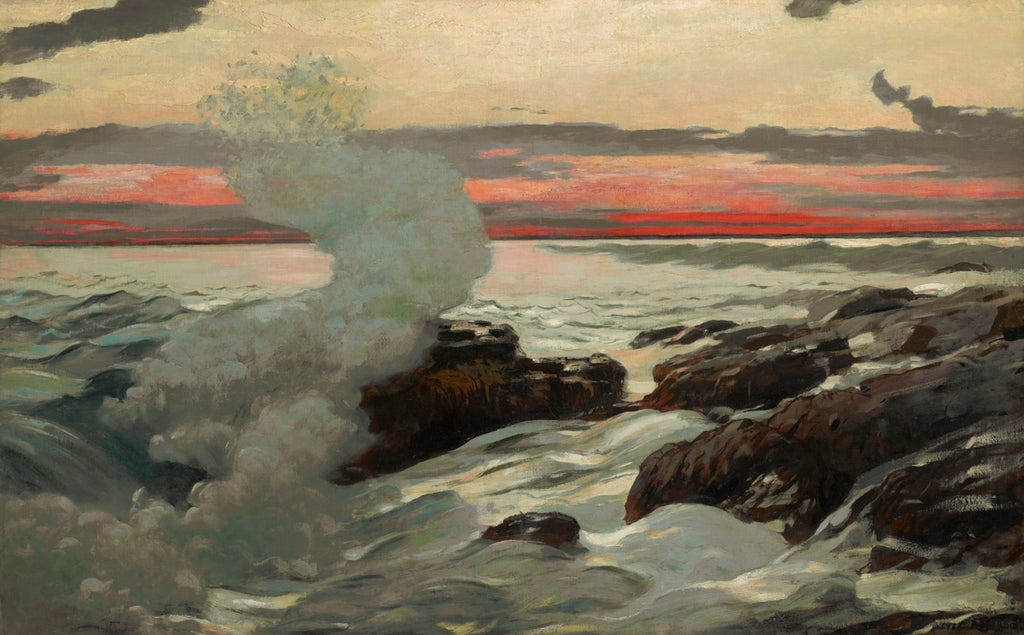
I. The Man Who Never Cries
The man who never cries is like the ship
That never sailed, or left the sleepy shores;
He's never felt the waves of peril whip
Against his keel, far off from peaceful shoals.
Fearing the unrelenting ocean’s guile
— The treasures claimed by wet tempestuousness —
A denizen upon Calypso’s isle,
He clings to beaches of voluptuousness.
When gazing from his tearless strand, he sees
In twirling clouds the faces he so loves;
He thinks of worlds across the salted seas,
Then looks to the lingering host above:
          His dreary eyes behold the pale, cruel waves
          As each cloud sinks horizon-ward and fades.
II. On a Shore
Cling to your shores timorous denizens!
Brave divers hunt for pearls, but tempered souls
Prefer the quiet shores and shallow shoals
To darkened depths and krakens’ midnight dens.
The diver takes one breath then disappears;
He seeks for precious treasures lost and found,
And lost again amid the coral-bound
Currents and briny waves and rotten piers.
Oh, how I wish I crossed these seas and swam
Before I knew what now I can’t unknow:
But now I dread to swim in depths so dim;
I curse the magic reefs where life began;
          I listen to the siren’s song, yet know
I’m safe: I cannot drown — nor can I swim.David B. Gosselin is a poet, translator, researcher and filmmaker living in Montreal, Canada. He publishes New Lyre Magazine. Discover some of his latest films, A Tale of Two Murders: Edgar Allan Poe’s Final Mystery & The Devil at Woodstock. His latest book is A Renaissance or New Middle Ages: Magic, Mystery and the Trance Formation.

Spanning the last five years of research, this book details the battle to shape the images of man across the ages. Our story includes magicians, clinicians, scientists, philosophers, occultists, artists and producers, among many characters. From the Neoplatonic perversion of the Renaissance and the creation of a new American mysticism to the emergence of pop culture and modern sci-fi, we lift the veil on the hidden spiritual and cultural war to shape the changing images of man.


Genius

Schiller entreats a spirit of Genius from a distant age to enlighten him about the path to true wisdom and happiness. The spirit refers him to a “Great Golden Age” where the eternal and divine was still equally clear and equally hidden to all men. But despite the fallen age which the narrator inhabits, the spirit of Genius reminds him that the real thin…
Well, at least your lines now scan.
I prefer the second sonnet. I particularly liked the last line.
To my mind the first one completely fails to penetrate the psychology of those macho men who avoid tears at all costs. I can't help thinking that any man luxuriating in this sort of lush romanticism would be weeping rather often.